2026-07-02 | 7 min | Equipe SingularidadeTech
Curitiba and metro area | all Brazil
Does a service provider need a sales page separate from the institutional website?
Understand the difference between a sales page and an institutional website for service providers, with conversion data and when to use each in Curitiba and Brazil.
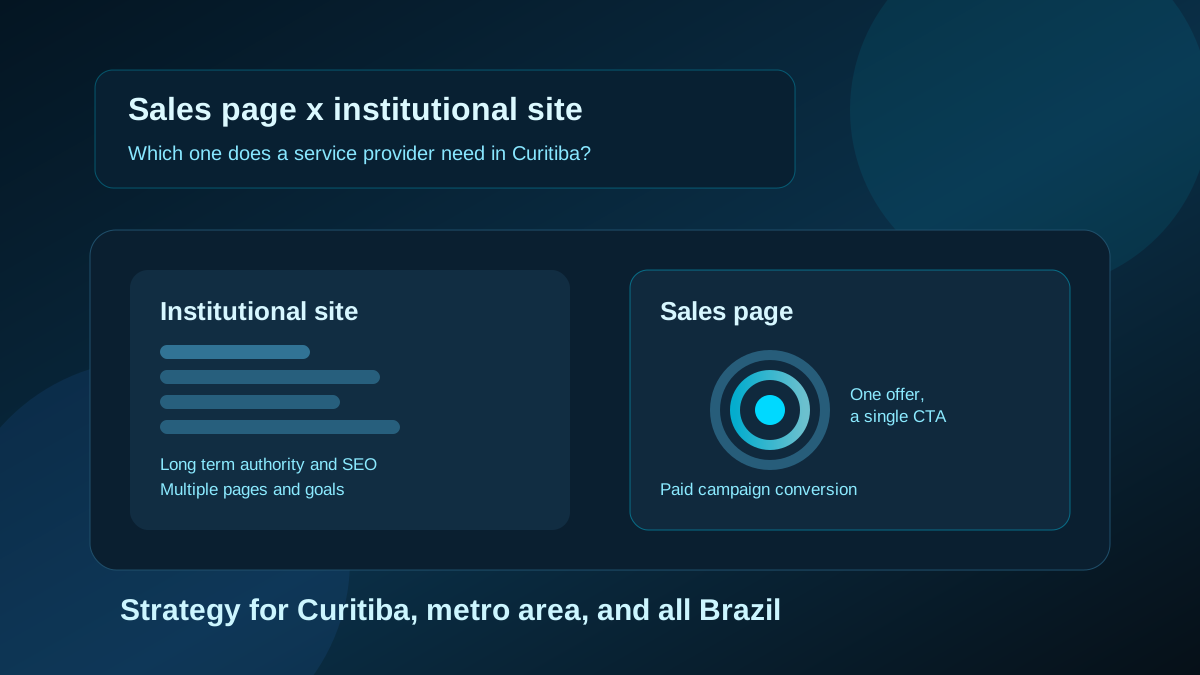
What is the difference between an institutional website and a sales page for a service provider?
An institutional website presents the business as a whole: who provides the service, specialties, portfolio, blog, and multiple contact options. It exists to build authority and answer questions from people who are still researching.
A sales page has a single goal: converting someone who already arrived interested in a specific offer, such as a free evaluation, a session package, or a consultation. It removes menus, exit links, and any distraction that pulls the visitor away from the contact button.
Sales page development to convert campaign traffic into customers
Why does a sales page convert more than an institutional website for a specific offer?
A study by Unbounce covering more than 41,000 landing pages and 464 million visits found a median conversion rate of 6.6%. For service lead-generation pages, a result between 6% and 8.5% is already considered healthy, and anything below 3% usually signals friction between the ad and the offer presented.
Part of this gain comes from simplicity: industry research shows forms with three fields convert around 25%, versus 15% for forms with six fields. An institutional website, with several menus and pages competing for attention, rarely delivers that same focus.
When should a service provider in Curitiba use a sales page?
The clearest moment is when running Google Ads or Meta Ads campaigns: sending paid clicks to the institutional homepage usually wastes budget, because the visitor has to search for the offer instead of finding it immediately.
It is also worth creating a sales page for launches, seasonal promotions, a new service package, or a special condition for a specific area of Curitiba and the metro region. In these cases, the sales page adds to the institutional website without replacing it.
What can a sales page that actually converts not miss?
Loading speed is decisive: pages that load in under one second can convert at 9.6%, compared to 3.3% for pages that take five seconds, a difference of nearly 200%. Since most campaign traffic today comes from mobile devices, the page needs to be designed mobile-first, not as a reduced version of the website.
It also helps to have a single call to action (preferably to WhatsApp), real social proof (photos, reviews, results), answers to common objections in an FAQ format, and, when possible, a short video showing the service, a format that can increase conversion by up to 86% compared to a text-only page.
How does a sales page improve Google Ads and Meta Ads results?
When the ad and the page speak the same language, with the same promise and the same offer, cost per lead tends to drop and contact quality improves, because only people who are genuinely interested in the advertised offer move forward.
A sales page also makes tracking easier: it becomes simpler to measure how many clicks turned into a WhatsApp message or a completed form, which helps the service provider know exactly how much they are paying per customer.
Does a sales page replace the service provider institutional website?
No. The institutional website remains important for SEO, long-term authority, and for people who research the company before closing a deal, even after seeing the sales page in an ad.
The ideal setup has both working together: the institutional website sustains continuous digital presence, while the sales page accelerates conversion for each campaign or specific offer.
Want to apply this to your business?
We structure website, landing page, and digital marketing campaigns to attract qualified customers.
I want a sales page for my service